

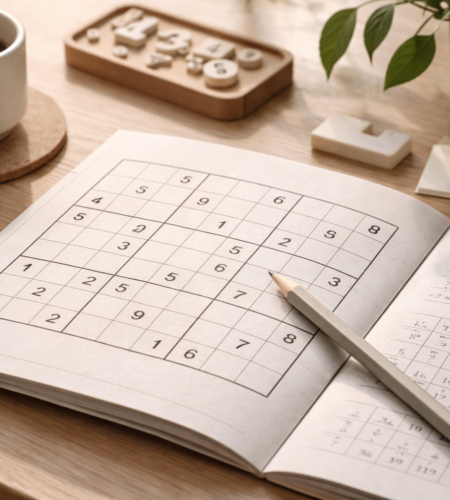
Sudoku is a logic puzzle based on placing numbers in a fixed grid. If you are learning how to play Sudoku, the goal is simple: fill the grid so that each number appears once in every row, column, and box.
The puzzle does not require math skills. The numbers act as symbols, not values. What matters is position and consistency, not calculation.
Each Sudoku starts with some numbers already filled in. These givens define the structure of the puzzle. From there, every move follows logical constraints. A well-designed puzzle can always be solved without guessing.
This guide explains how to play Sudoku clearly, starting with the structure, then the rules, and finally a basic strategy you can apply immediately.
What Is Sudoku
Sudoku is played on a 9×9 grid divided into nine smaller 3×3 boxes. Some cells contain numbers at the start. The rest are empty.
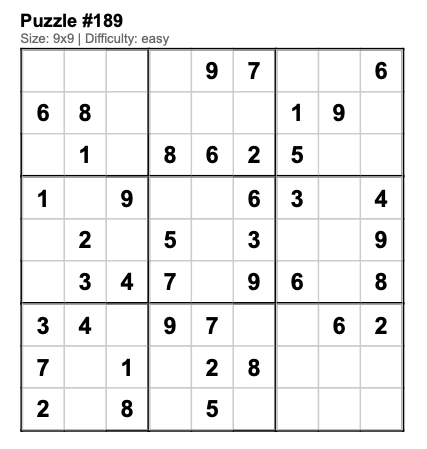
The objective is to complete the grid using numbers from 1 to 9. Each number must appear exactly once in:
- Every row
- Every column
- Every 3×3 box
There is only one correct solution for each valid puzzle.
Sudoku is not about speed or tricks. It is about applying consistent rules and reducing possibilities step by step.
Understanding the Sudoku Grid
Rows, Columns, and Boxes
The grid has three overlapping systems:
- Rows (horizontal lines)
- Columns (vertical lines)
- Boxes (3×3 sections)
Each cell belongs to all three. That means every number you place must satisfy all constraints at once.
For example, if you place a 7 in a cell, that number cannot appear again in the same row, column, or box.
This interaction between constraints is what drives the puzzle forward.
Given Numbers
The numbers you see at the beginning are fixed. You cannot change them.
They act as anchors. Each given number reduces the number of possible placements for the remaining cells.
The difficulty of a Sudoku puzzle depends more on how these numbers are arranged than on how many there are.
How to Play Sudoku – Rules You Need to Follow
If you want to understand how to play Sudoku correctly, you only need to remember three rules:
- Each row must contain numbers 1–9 without repetition
- Each column must contain numbers 1–9 without repetition
- Each 3×3 box must contain numbers 1–9 without repetition
That’s all.
There are no additional conditions, no hidden mechanics, and no exceptions.
Everything you do in Sudoku comes from applying these three rules consistently.
How to Play Sudoku Step by Step
Step 1: Look for Easy Placements
Start by scanning the grid.
Find rows, columns, or boxes that are almost complete. If only one number is missing, you can place it immediately.
This is the fastest way to begin.
Step 2: Use Elimination
For each empty cell, check which numbers are already used in:
- The same row
- The same column
- The same box
Remove those numbers from consideration.
If only one number remains possible, that is the correct value.
Step 3: Add Candidate Notes
When a cell has multiple possibilities, write small notes (often called pencil marks).
For example, a cell might allow 2, 4, or 8.
Keeping track of candidates helps you see patterns later. It also prevents repeated checking of the same constraints.
Step 4: Focus on One Area
Work through one box or one row at a time.
This keeps your attention focused and reduces mistakes. It also makes it easier to spot missing numbers or limited options.
Step 5: Repeat and Refine
Each correct placement changes the grid.
After placing a number, revisit nearby cells. Remove invalid candidates and check for new forced moves.
Progress builds gradually.
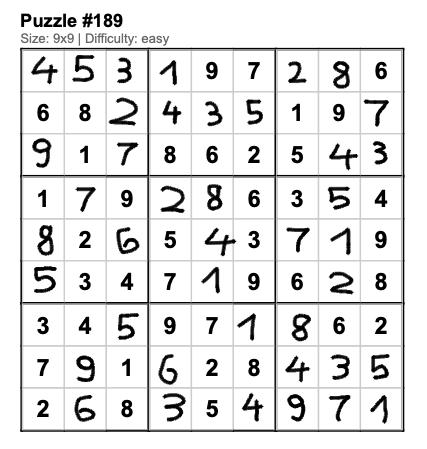
Try a Free Sudoku Pack
If you want to practice right away, you can use a small printable set.
- 24 Sudoku puzzles
- Clean layouts for easy solving
- Suitable for beginners and intermediate players
- Includes solutions
Download:
Free Sudoku PDF – 24 Puzzles
Free Sudoku Solutions PDF
How to Play Sudoku – Basic Strategy
Scanning
Regularly scan rows, columns, and boxes for missing numbers.
Even if nothing looks obvious at first, a quick review often reveals new placements after each step.
Single Possibility
If a cell has only one possible number, place it.
This is the most reliable method and should be used throughout the puzzle.
Unique Candidate
Sometimes a number can only appear once within a row, column, or box, even if multiple cells are still empty.
If a number has only one valid position in that area, it must go there.
Keep Notes Clean
Candidate notes are useful only if they are accurate.
Update them as soon as new numbers are placed. Remove options that are no longer valid.
Clean notes reduce confusion and make patterns easier to see.
Common Mistakes to Avoid
Guessing Too Early
Sudoku does not require guessing.
If you feel stuck, it usually means you missed a constraint or need to review your notes. Guessing often leads to errors later.
Ignoring One Constraint
Every placement must satisfy row, column, and box rules at the same time.
Focusing on only one of these can cause mistakes.
Not Updating Candidates
Outdated notes create false possibilities.
Always remove invalid numbers after each placement.
Why Learning How to Play Sudoku Matters
Sudoku trains a specific type of thinking.
It requires:
- Attention to detail
- Consistent rule application
- Step-by-step reasoning
You do not need to hold the entire puzzle in your head. Instead, you work through small, manageable decisions.
This makes Sudoku a practical exercise in structured thinking. The same approach applies to planning systems, logic problems, and many forms of analytical work. These benefits are not unique to Sudoku and appear across different puzzle types, as outlined in How Logic Puzzles Improve Focus and Pattern Recognition.
It is also easy to integrate into a daily routine. A single puzzle provides a clear start and finish, which makes it suitable for short, focused sessions.
Printable Sudoku for Regular Practice
If you prefer solving on paper, printable Sudoku offers a more focused experience than solving on a screen. It removes distractions and makes it easier to stay consistent.
For this purpose, I’ve created a set of printable Sudoku puzzles designed for regular use. It includes a large number of puzzles across different difficulty levels, along with multiple layout options depending on how you prefer to solve.
You can view it here:
800 Sudoku Puzzles – Printable PDF on Etsy
Conclusion
Learning how to play Sudoku starts with understanding the grid and the three core rules. From there, progress comes from simple techniques like scanning, elimination, and tracking candidates.
A structured approach makes the process predictable. You do not need advanced tricks to solve most puzzles. Consistency and attention are enough.
Sudoku remains effective because it is clear, contained, and logical. Each puzzle is a closed system with a defined solution. That makes it both a reliable mental exercise and a practical way to develop disciplined thinking.
Comments